
What the Oracle Bones Recorded
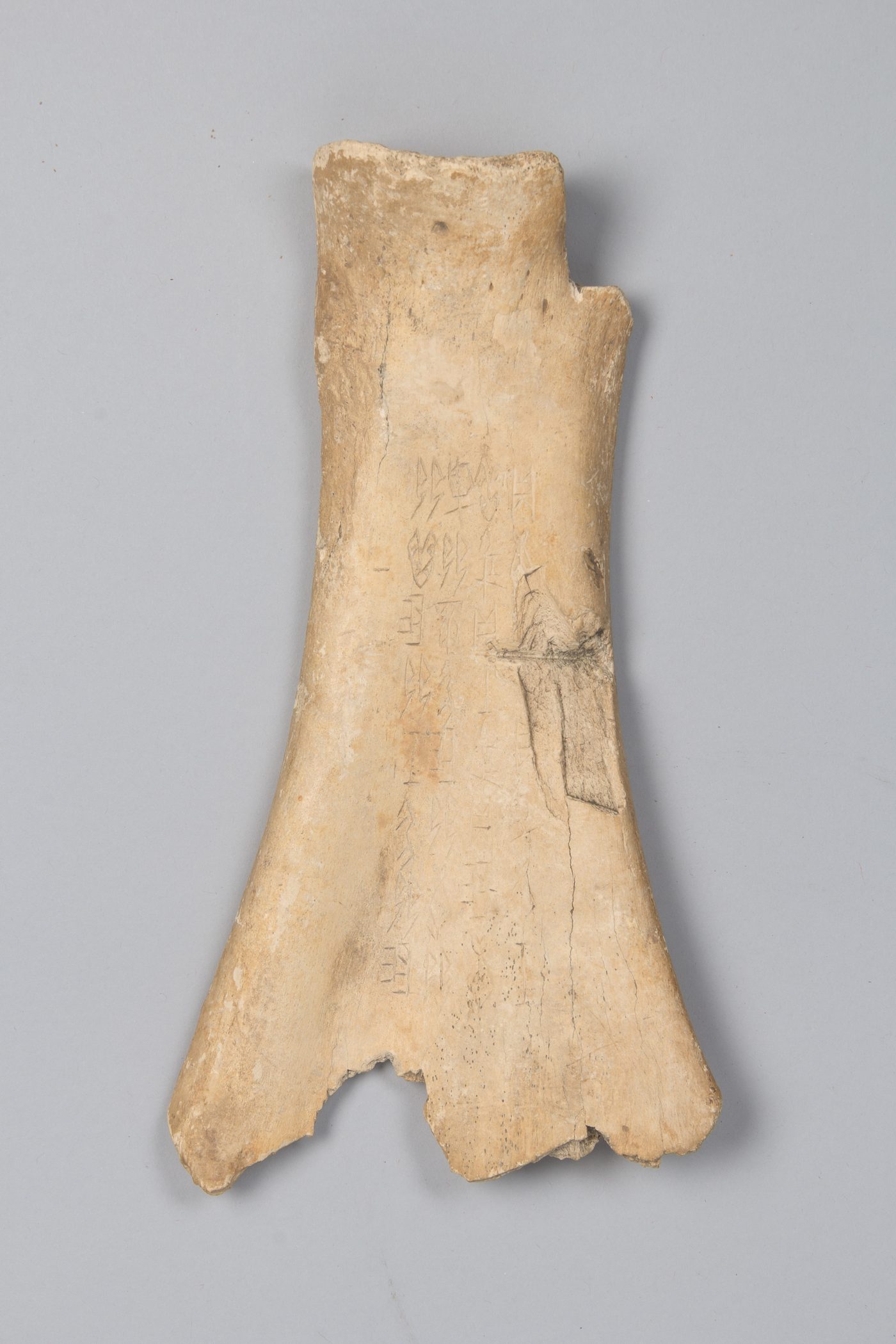
A decision that will not resolve itself tends to produce the same thought on a loop: what if I am wrong, and how would I know in time. Around 1200 BCE, in the Shang court, that loop had a physical outlet. It got carved into bone.
A Shang king did not simply wonder whether to go to war, when to plant, or what an illness meant. The uncertainty was written down, literally, on an ox shoulder blade or the underside of a turtle shell, in the form of a direct question addressed to a royal ancestor. A diviner then pressed a heated rod into the bone until it cracked, and read the shape of the fracture as the ancestor's reply.
The process followed a consistent sequence, reconstructed from inscriptions that survive in the hundreds of thousands: a charge, the question itself, carved first. Then the application of heat. Then the crack, read on the spot. Then, in a detail easy to miss, a later inscription sometimes added afterward, recording whether the predicted outcome actually came true.
That last step is the one worth sitting with. The Shang were not just recording a moment of uncertainty and an answer. They were building a verification record, a way of checking, sometime later, whether a specific thought about the future had held up. The oracle bones are, among other things, the earliest surviving paper trail of a civilization auditing its own predictions.
The questions themselves were not abstract. Will the harvest come in. Will the army prevail. What does this dream mean. What illness is this. A thought too large to sit with privately got externalized onto a shell, heated until it cracked, and treated as a question worth a formal, repeatable procedure rather than a private spiral.
No feature of this ritual proves a king's uncertainty was resolved correctly, and no modern reader needs to accept the ancestors as the actual source of the answer to find the structure worth noticing. A doubt was named precisely enough to carve. A method was applied consistently enough to repeat, thousands of times, across centuries. And someone, afterward, occasionally came back to check whether the thought had been right.